Major Brazilian news outlets cover World Prison Brief data on women in prison
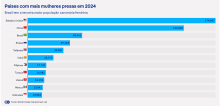
A powerful news report on Brazil’s dramatic rise in female prisoner numbers has used data from our World Female Imprisonment List.
A powerful news report on Brazil’s dramatic rise in female prisoner numbers has used data from our World Female Imprisonment List.
This year marks a remarkable milestone: the 25th anniversary of the World Prison Brief. What began as a modest attempt to compile worldwide prison data has evolved into an indispensable resource accessed over 2.7 million times by more than 524,000 users from 230 countries and territories in 2025 alone.
At regular intervals over the past year or so, reporters have contacted us about foreign nationals in prison. Usually, they are looking for context and comment on controversial proposals emanating from the USA, the UK, Sweden and Denmark to remove foreign nationals from their prisons and send them to third countries with which they lacked any connection.
Well over three million people are held in pre-trial detention and other forms of remand imprisonment throughout the world, according to the latest edition of the World Pre-trial/Remand Imprisonment List (WPTRIL), published today by the Institute for Crime & Justice Policy Research at Birkbeck, University of London. The List can be found here
Data from ICPR’s latest edition of the World Female Imprisonment List (published in February 2025) have been used extensively in two articles in The Guardian. The data in the List are compiled from information held on the World Prison Brief (WPB) database and lead researcher Helen Fair is also quoted noting the gaps in the availability of data on the number of women in prison around the world.
The Agora Center for Research recently released a report documenting brutal conditions in Uganda's prisons, where thousands of prisoners are forced into unpaid labor and experience violence and degradation. This blog examines how Uganda's prison system, despite more than six decades of political independence, continues to function according to its original colonial design: not as a site for rehabilitation, but as a mechanism for labor extraction and state control.
Zinat Jimada discusses a recently enacted California law that requires incarcerated firefighters to be paid the federal minimum wage, and explores the situation in Nevada, where a similar proposal to raise pay for working prisoners failed to pass.
The event to celebrate the 25th anniversary of the World Prison Brief website has been postponed until early in 2026.
World Prison Brief data has been cited in an article in The Economist looking at the increasing number of European countries that are renting prison cells in neighbouring countries to reduce prison overcrowding by sending their foreign national prisoners there.
The law, policy and practice of prison work provision in Brazil are explained in a new briefing by the Institute for Crime & Justice Policy Research.